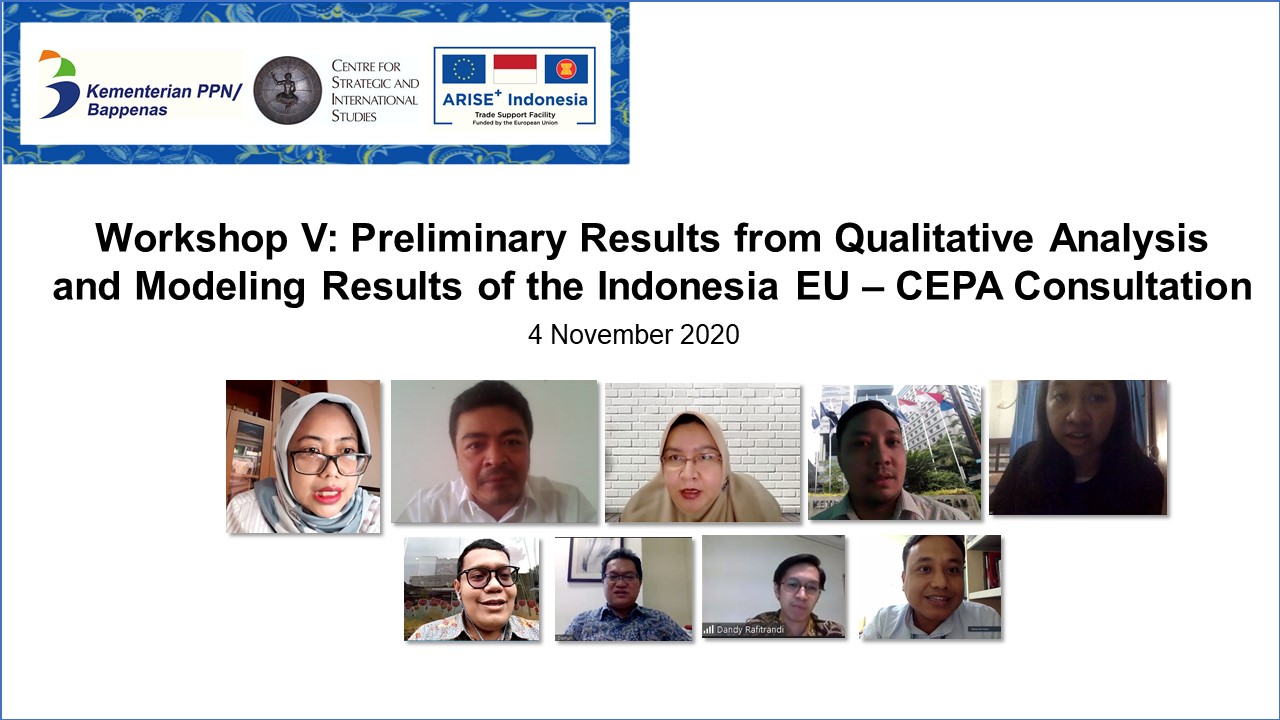
The Ministry of National Development Planning (BAPPENAS) and the Ministry of Trade discussed the preliminary analysis of the Qualitative Analysis and Modelling Results of the of the Indonesia – European Union (I-EU) CEPA consultations, on 4 November 2020. As the I-EU CEPA negotiations are progressing, these consultations provide important contributions to maximise the benefits of the agreement.
ARISE+ Indonesia and CSIS presented the outcomes of the extensive consultations held with local governments, Free Trade Agreement (FTA) Centers of the Ministry of Trade, the private sector, business organizations as well as micro, small and medium enterprises (MSME) through in-depth interviews and FGDs. Consultations were also held in the provinces of South Sulawesi and North Sumatra and Jakarta. Most of these had to take place online due to the current restrictions and included 31 business entities.
This round of consultations had four objectives: to capture the perceptions of business actors on the I-EU CEPA, identify potential benefits and challenges on implementation, gather insights to increase its use and raise awareness of key stakeholders on the proposed agreement.
The consultations showed that the agreement is expected to increase the competitiveness of Indonesian products in Europe. The I-EU CEPA will open access to a market of 500 million consumers to Indonesian businesses with preferential tariffs on a substantial amount of products. Another benefit is the potential to increase investments in Indonesia, including in services industries. However, there are several challenges that must be overcome to take advantage of the arrangement. For instance, the EU has high level product quality standards, especially health and safety related standards. Indonesian enterprises, especially MSMEs, may not have the necessary information and resources to comply with such standards. The workshop also offered the opportunity to participants to take note of the results of simulation analysis that used three models namely GTAP, IndoTERM and Microsimulation.
From the discussions it emerged that the private sector is very positive about the I-EU CEPA negotiations. They believe that the I-EU CEPA will offer important growth prospects to Indonesian businesses and the Indonesian economy in general. However, support will be needed from the government to address some challenges. Importing firms see that it will be easier to import EU products to Indonesia. According to exporting firms, there is a strong interest in Indonesian products. It is expected that information on EU import procedures will be more accessible after the agreement is signed. It was observed however that logistics costs are still restrictive and improvements are required in facilitating the import of intermediate goods, for example by reviewing physical inspection procedures at the border and in lowering taxes on certain goods such as industrial equipment.
The FGDs have been very effective for obtaining useful inputs from key stakeholders and will therefore, be pursued. Participants suggested that the final study be communicated to the key stakeholders involved in the consultation.
Please get the workshop materials here.